Loyalty engine
Ten stamps is
not a strategy.
A punch card treats your best guest and a stranger identically, and tells you nothing about either. Habitu's loyalty engine is configured, not engineered: earn rules, VIP tiers and rewards, set up in an afternoon and running on the POS you already have.
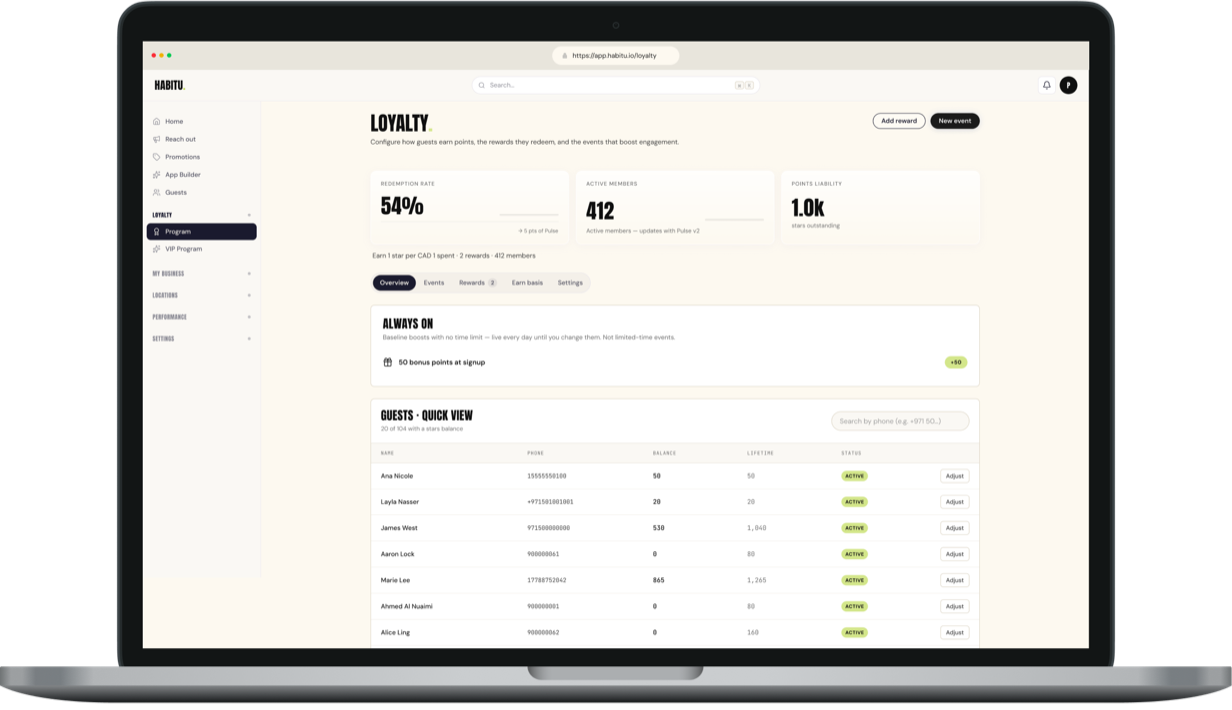
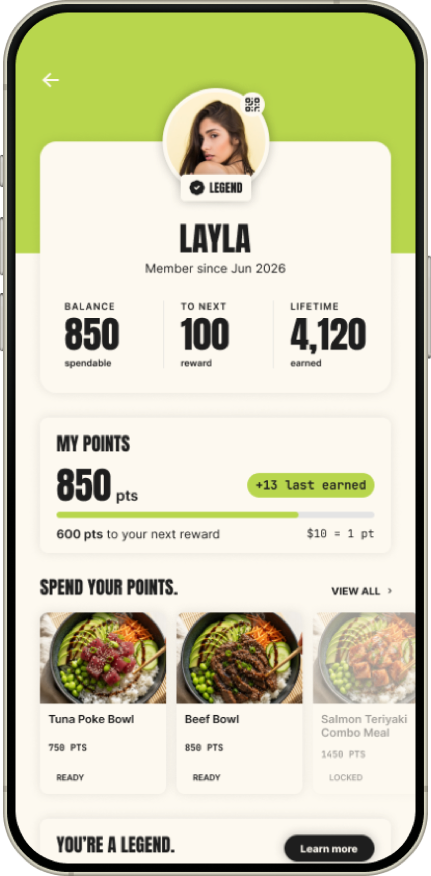
Points land from the POS on every visit: by visit, by spend, or both.
Members trade points for rewards you define: a free item, a percentage, an amount.
Tiers move members up automatically, and the app tells them the moment it happens.
See the projected cost of your generosity before a single member sees it.
What is a restaurant loyalty program?
A restaurant loyalty program rewards guests for coming back, usually by giving points for visits or spend, which members exchange for free items or discounts. A modern one also records who each guest is and how their behaviour changes, so the brand can act on it. That second half is what separates a loyalty programme from a punch card.
- Earn rule
- What a guest gets for a visit or an amount spent. Habitu supports visit-based, spend-based, multipliers, welcome and bonus rules.
- VIP tier
- A status level a member reaches by visiting or spending, carrying perks and a faster earn rate.
- Redemption
- The moment points become a reward. Habitu settles these atomically, so a double-tap cannot spend the same points twice.
- Liability
- Points issued but not yet redeemed. A real cost sitting on your programme. Expiry rules and a budget rail keep it bounded.
Earn rules
Reward the behaviour you actually want.
Frequency matters to a coffee shop; basket size matters to a fine-casual brand. Set the mechanic that matches how your guests actually visit, per brand and per location, without opening a ticket with anyone.
Visit, spend, or both
Points per visit, points per amount spent, or a hybrid, with multipliers layered on top.
Welcome and bonus rules
Start a member with a balance so their first reward feels reachable, and add bonus rules for the moments you care about.
Expiry that you control
Inactivity-based expiry keeps the liability ledger clean and gives dormant members a reason to return.
Earn shown before they pay
The cart previews what an order will earn, so the incentive lands while the guest is still deciding.
Earn basis decides whether points are calculated before or after tax, a real accounting choice rather than a cosmetic one. Bonus events sit on top of the base rate and each carries its own window.
VIP tiers
Status outperforms discount.
A discount costs margin every time it lands. Status costs nothing and compounds: members who can see the next tier change their behaviour to reach it, and members who hold one behave differently from members who do not.
Four-step setup
A guided wizard with five venue-type blueprints. Launch a sensible programme in minutes, then edit anything.
Twelve perk types
Across four categories, so tier value can be exclusivity and access rather than another percentage off. Four of them are fulfilled by your staff and labelled as such.
Faster earning at the top
A per-tier multiplier makes higher tiers worth reaching and worth keeping.
Evaluated automatically
A qualifying order at 11pm on a Friday promotes the member then, not on Monday when someone runs a report.
Where do you want to start?
Most merchants start from a preset built for their venue type. It pre-fills the framework, thresholds, and a default perk set. You can tweak everything in the next steps, or pick Custom to design the framework yourself.
Reward visit frequency. Bronze unlocks at 8 visits, Gold at 30. Tuned for 2–3 visits per week.
Reward basket size. Member tier unlocks at modest annual spend, Patron at ~6× that. Quiet, status-forward perks.
Choose the metric, tier count, and window yourself. Best when your venue doesn’t fit a preset: hotels, mixed-format brands, multi-concept groups.
Step 1 of the VIP wizard as it ships: the step bar, the preset grid, and the real preset copy. Thresholds, perks and a publish review follow. Tier names and unlock points are the preset’s defaults; every one is editable before anything goes live.
Cost control
See what generosity costs before you publish.
Most loyalty programmes discover their true cost in a month-end report. Habitu puts the forecast next to the design: set a rail as a share of sales, and watch the projection move as you change a multiplier or add a perk.
A rail, not a surprise
The projected cost of fulfilling your tier perks, as a percentage of sales, checked against the cap you set.
Schedule the change
Stage a tier restructure to go live alongside a campaign instead of publishing it by hand at midnight.
Every point accounted for
An immutable event ledger records each point earned and spent. The record you need when finance asks.
Fix mistakes cleanly
Manual adjustments for goodwill, corrections and refunds, logged like everything else.
The percentage is the load-bearing number: cost against your own ceiling, not a currency figure. The value slot is blank because the product renders it in your brand’s own currency and this site never picks one. Below 80% of the ceiling reads calm, 80–100% warns, at or over it turns red.
Going live
No silent demotions.
The most common way a loyalty relaunch goes wrong is quiet: the structure changes and a brand's best regulars drop a tier without anyone noticing. Habitu shows you the movement before you publish, caps how far anyone can fall, and tells the member on their own card.
Diff before publish
See exactly who moves up, who stays, and who would drop, while nothing is live.
Capped descent
A member can drop at most one tier per evaluation, so a restructure never sends a Gold regular back to the bottom in one step.
Preview as a member
Check the guest-side experience from the dashboard before publishing, without a second login.
The moment they level up
Promotion fires a celebration in the app once per member, cross-device. Status is worth nothing unnoticed.
Click any tier to jump back and refine. Counts are projected from your own member base by the cost-preview call, so the shape you approve is the shape that ships.
Questions operators ask.
How long does it take to launch a loyalty program?
The VIP tier setup is a guided four-step wizard with five venue-type blueprints behind it, so a sensible first programme is a matter of minutes rather than a consulting engagement. Every preset is fully editable. The blueprint is a starting point, not a constraint.
Do my guests need to download an app to earn points?
No. Members sign up with a phone number and a one-time code, and points accrue automatically from the POS on every visit. The branded guest app is where they check their balance and redeem, and it opens from a link or a QR code at the counter.
Can I run different loyalty rules at different locations?
Not today. A brand runs one loyalty programme, so earn rules and tiers are consistent across every site. What is per-location is the layer above it: campaigns target the guests of a single branch, and the dashboard scores each location separately so you can see which one needs attention.
What stops a loyalty program from costing more than it earns?
A budget governor projects the cost of your tier design as a share of sales before you publish, against a rail you set. Change a multiplier and the forecast moves with it, so the trade-off is visible at design time rather than discovered in a month-end report.
What happens to my existing members when I change the tier structure?
Publishing shows a diff first: who moves up, who stays, and who would be demoted. Demotion is then capped at a single tier per evaluation, and members at risk see it on their own tier card rather than discovering it silently, so a restructure cannot drop a long-standing regular several levels overnight.
Does it work with my POS?
Square is live end-to-end, including a mirror mode that keeps an existing Square loyalty programme intact so members do not have to re-enrol. The Foodics adapter is post-pilot; Foodics operators run Habitu's own loyalty engine in the meantime.
Can I call points something other than points?
Yes, the loyalty terminology is yours to set. A coffee shop can run on beans, a bakery on crumbs. It reads as your programme, not a platform's.
See it running on your menu.
Thirty minutes, configured to your brand. Not a slide deck.
Book a demo →